By Allan M. Siegel, Partner — Chaikin, Sherman, Cammarata & Siegel, P.C.
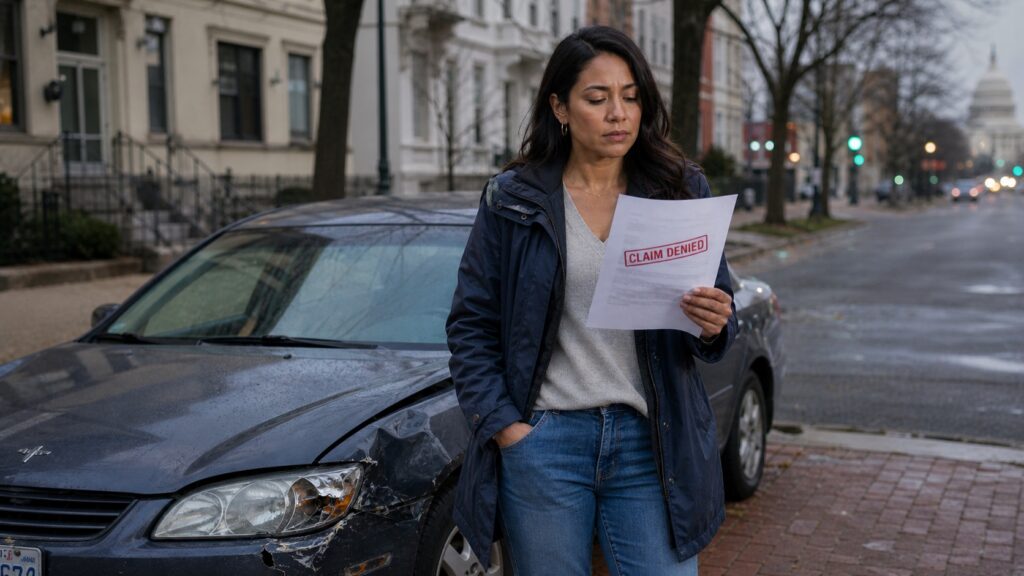
Can your auto insurer simply refuse to pay after a crash? Increasingly, this is happening, and more often than most drivers expect. Across the industry, insurers now close nearly half of auto liability and medical claims without paying anything. In Washington, DC, Maryland, and Virginia, a strict fault rule can make those denials even easier. Here is how it happens, why it happens, and what you can do if it happens to you.
How Often Do Auto Insurers Actually Deny Claims?
The odds of an injury claim going unpaid have been climbing for a decade. A 2026 Wall Street Journal analysis of thousands of insurer filings to the National Association of Insurance Commissioners (NAIC) found that insurers did not pay out on 45% of the auto liability and medical claims they resolved in 2025 — up from roughly 35%, about one in three, ten years earlier. With more than six million traffic accidents in a typical year, that shift touches a very large number of people.
Not every claim carries the same odds. The Journal drew a sharp line between two categories:
- Auto damage claims — collision and comprehensive coverage that repairs or replaces your vehicle. Just under one in four resolved claims produced no payment in 2025, roughly the same rate as a decade ago.
- Liability and medical claims — injuries and losses from a crash, plus uninsured and underinsured motorist (UM/UIM) claims. This is where nonpayment has climbed toward a coin flip.
The Journal was careful about what “closed without payment” means. Some claims fall below the deductible, some are withdrawn by the customer, some are paid by the other driver’s insurer, and some fall outside the policy’s terms. A claim closed without payment is not always a wrongful denial. But the decade-long direction — fewer payouts on the exact claims that matter most after a serious injury — is real, and it mirrors what the Journal previously documented in home insurance.
One more figure worth holding onto: in 2025, personal auto insurers paid roughly 61 cents in claims for every premium dollar — their lowest net loss ratio since 2020, according to S&P Global Market Intelligence. In plain terms, a larger share of premium dollars is staying with insurers rather than flowing back to policyholders as claims.
Why Claims Are Being Denied — Two Very Different Explanations
Insurers and consumer advocates do not agree on the cause. The industry points to fraud — including fake claims enhanced with AI tools — and to lawyers. “People are going to litigation as a first step, instead of a last resort,” the chief executive of the Insurance Information Institute told the Journal.
Plaintiff attorneys say the causation runs the other way. “Litigation is increasing because more claims are being denied — not the other way around,” said John Morgan, founder of Morgan & Morgan. Consumer advocates are blunter still: “The industry uses claim lowballing and denials to wring extra profit out of customers who don’t have the resources or, in some states, the rights to fight back,” said Douglas Heller of the Consumer Federation of America.
Beyond the debate over motive, the Journal documented two concrete mechanisms that lead to more denials:
- Undisclosed-driver crackdowns. Starting in October 2025, State Farm added a “duty to notify us of changes” — including any new regular driver of the car — to renewal policies, after internal documents estimated that undisclosed drivers cost it nearly $1.5 billion a year. An internal memo suggested the change would allow the insurer to deny claims in scenarios it would once have paid.
- Application “gotchas.” In a California case now part of a class action, an Allstate-owned insurer (National General) refused to pay a $5,000 liability claim after a minor bumper accident because the policyholder had not listed his 15-year-old son — who was not driving and did not even have a license — on the application. National General has denied any wrongdoing in response to the lawsuit.
“The people who come to us aren’t looking for a windfall — they’re looking for the coverage they paid for, and are entitled to. When insurers walk away from nearly half of these claims, the cost of a crash gets shifted onto the person who did nothing wrong. That’s a pattern we see, and it’s one we’re built to challenge.” – Allan Siegel
Why This Hits Harder in DC, Maryland, and Virginia
Here is the part national coverage usually leaves out: the DC–Maryland–Virginia region is one of the hardest places in the country to make a claim, because all three jurisdictions still follow the strict doctrine of contributory negligence.
Under contributory negligence, if you are found even 1% at fault for a crash, you can be barred from recovering anything at all. Most states abandoned this rule long ago in favor of comparative negligence, which reduces recovery in proportion to fault. DC, Maryland, and Virginia are among the small handful that kept the all-or-nothing version. For an insurer looking for a reason not to pay, that is a powerful lever: an argument that you contributed to the collision can end the claim outright, even if it is not really substantiated.
DC does carve out a limited exception for vulnerable users — pedestrians, cyclists, and other non-motorized users are evaluated under a comparative standard under D.C. Code § 50-2204.52. For most drivers, though, the strict rule controls.
Jurisdiction-specific realities to keep in mind
- Deadlines to sue. DC and Maryland generally give you three years from the date of injury to file suit (D.C. Code § 12-301(a)(8)); Virginia generally gives you only two (Va. Code § 8.01-243). Miss the deadline and even the strongest claim is worth nothing. There are certain circumstances where deadlines may be even sooner, so it is important to consult with a lawyer.
- Uninsured/underinsured motorist coverage. When the at-fault driver has no insurance or not enough, your own UM/UIM coverage may be your only source of recovery — and those are precisely the liability/medical claims the Journal found are increasingly denied. Minimum limits differ by jurisdiction (DC is $25,000/$50,000/$10,000; Virginia raised its minimums to $50,000/$100,000/$25,000 effective January 1, 2025; see Va. Code § 38.2-2206).
- DC’s optional PIP election. In DC, drivers generally have 60 days after a crash to elect no-fault (PIP) benefits — a choice with real consequences for the right to sue (D.C. Code § 31-2405).
Our Firm’s Experience With Denied and Underpaid Claims
For more than four decades, Chaikin, Sherman, Cammarata & Siegel, P.C. has represented injured people across DC, Maryland, and Virginia, recovering over $1 billion on their behalf. The firm’s partners have tried and settled thousands of injury cases in the same courts where these coverage disputes are decided.
Allan M. Siegel, a partner at the firm, is board-certified in Civil Trial Law by the National Board of Trial Advocacy — a credential held by a small fraction of U.S. attorneys — and was named the 2024 Trial Lawyer of the Year by the Trial Lawyers’ Association of Metropolitan Washington, DC. He has handled more than 1,000 cases across the three jurisdictions and holds leadership roles in the American Association for Justice’s trucking, brain injury, and rideshare litigation groups.
“A denial letter is the insurer’s opinion — it is not the final word. The court system is designed to hold insurers responsible for claims they are obligated to pay, and we are prepared to fight for our clients when they are treated unfairly. – Allan M. Siegel
The Policy-Language Trap — and Why Accountability Matters
The National General case is a warning about a broader tactic: building the denial argument into the fine print of the application and the policy, then invoking it only after a crash. When the terms are written to create an “out,” the coverage a driver believed they bought can turn out to be narrower than they were ever told. Joseph Cammarata, Senior Partner at the firm and a 2026 Virginia Lawyers Hall of Fame honoree, has spent his career on the principle that every person is entitled to the same access to justice as the most powerful party on the other side.
What to Do If Your Auto Claim Is Denied or Lowballed
- Get the denial in writing. Ask the insurer to identify the exact policy provision it is relying on. A vague verbal “no” is not the same as a documented, cited denial.
- Preserve evidence early. Save photos, the police or crash report, medical records, witness names, and the other driver’s insurance information before anything is lost.
- Be careful with recorded statements. Adjusters may ask for a recorded statement soon after the crash. In a contributory-negligence jurisdiction, an offhand comment can be used to argue you were partly at fault.
- Don’t treat the first offer as the last word. A quick, low offer is not an independent valuation of your claim.
- Watch the deadline. Two years in Virginia, three in DC and Maryland — and shorter notice deadlines can apply to UM/UIM and government-vehicle claims.
- Get an independent review. An attorney can read the policy, test the insurer’s stated reason, and — where warranted — challenge a denial or underpayment.
The Bigger Picture
Drivers are required to carry auto insurance as a condition of getting behind the wheel. The reasonable expectation in return is a financial backstop when something goes wrong. The Journal’s findings suggest that backstop is thinner than many people assume — and in DC, Maryland, and Virginia, a strict fault rule can widen the gap between the coverage a driver paid for and the recovery they actually receive. Understanding how the rules work in this region, and acting before deadlines pass, is the difference between a claim that gets paid and one that quietly closes at zero.
Frequently Asked Questions
Can an auto insurer refuse to pay my car accident claim?
Yes — and it happens more often than most drivers expect, especially on injury and liability claims. A 2026 Wall Street Journal analysis of NAIC filings found insurers closed 45% of auto liability and medical claims without payment in 2025, up from about 35% a decade earlier. Auto damage (collision/comprehensive) claims were denied far less often, at just under one in four. A denial is not the final word, but how you respond — and how quickly — matters.
What does “claim closed without payment” actually mean?
It means the insurer resolved the claim without paying out. That can happen for several reasons: the loss fell below the deductible, the customer withdrew the claim, another driver’s insurer paid it, or the claim fell outside the policy’s terms. A claim closed without payment is not always a wrongful denial — but the rising rate on injury claims is worth understanding, especially in a strict-fault jurisdiction.
Can my insurer really deny a claim because a household member wasn’t listed on the policy?
Some insurers are trying. The Journal documented “undisclosed driver” initiatives and a class action over an insurer that denied a claim because a teenage household member was not listed — even though he wasn’t driving and had no license. Whether such a denial holds up depends on the policy language and the facts. If you receive one, have the denial and your policy reviewed rather than accepting it at face value.
What is contributory negligence, and why does it matter in DC, Maryland, and Virginia?
Contributory negligence is an all-or-nothing fault rule: if you are found even 1% responsible for a crash, you can be barred from recovering anything. DC, Maryland, and Virginia are among the few jurisdictions that still follow it. That makes a partial-fault argument a powerful tool for an insurer looking to deny a claim, and it makes careful handling from the outset especially important.
How long do I have to file a car accident lawsuit in DC, Maryland, or Virginia?
As a general rule, three years from the date of injury in DC (D.C. Code § 12-301(a)(8)) and Maryland, and two years in Virginia (Va. Code § 8.01-243). Different or shorter deadlines can apply — for claims against government entities, for certain UM/UIM notice requirements, and in other situations — so it is best to confirm your specific deadline early.
What is uninsured/underinsured motorist coverage, and when does it apply?
UM/UIM is coverage on your own policy that can pay when the at-fault driver has no insurance or not enough to cover your losses. Because it is one of the liability/medical categories the Journal found increasingly denied, and because minimum limits vary by jurisdiction, it is worth confirming what UM/UIM coverage you carry before you ever need it.
Should I give the insurance adjuster a recorded statement?
Be cautious. You are generally required to cooperate with your own insurer, but you are not obligated to give the at-fault driver’s insurer a recorded statement, and what you say can be used to build a fault argument against you. Consider speaking with an attorney before providing one.
What can I do if I believe a legitimate claim was wrongly denied?
Get the denial in writing with the specific policy provision cited, preserve your evidence, mind the filing deadline, and have the denial independently reviewed. An attorney can assess whether the insurer’s stated reason holds up under the policy and the law of your jurisdiction.
About Chaikin, Sherman, Cammarata & Siegel, P.C.
Chaikin, Sherman, Cammarata & Siegel, P.C. is a Washington, DC personal injury firm representing injured people across DC, Maryland, and Virginia in car accident, truck accident, brain injury, medical malpractice, and premises liability matters. The firm has recovered over $1 billion for its clients. Office: 1232 17th Street NW, Washington, DC 20036 · (202) 659-8600. See our results and learn about the firm.
Talk to a DC, Maryland, or Virginia Injury Attorney
If your auto insurer has denied or underpaid a claim after a crash in DC, Maryland, or Virginia, contact Chaikin, Sherman, Cammarata & Siegel, P.C. at (202) 659-8600 for a free, no-obligation consultation. You can also request a free case review online.
Disclaimer: This post reflects Chaikin, Sherman, Cammarata & Siegel, P.C.’s commentary on a matter of public record and general information about the law in DC, Maryland, and Virginia. It is not legal advice and does not create an attorney-client relationship. Laws, deadlines, and insurance requirements change and apply differently to individual facts. Prior results do not guarantee or predict a similar outcome in any future case; every matter is unique and must be evaluated on its own facts. Readers with specific legal questions should consult qualified counsel.