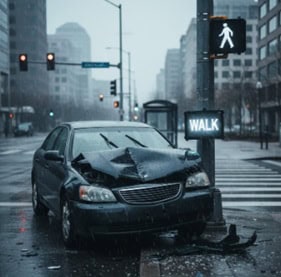
When a driver hits you on a DC street, you expect their insurance to cover your medical bills. What you don’t expect is to learn that the District’s minimum insurance requirements haven’t been updated in 39 years.
Every driver in DC is legally required to carry auto insurance with certain minimum coverage amounts — these are the lowest insurance limits the law allows. Think of it as the bare minimum safety net. The current minimum for bodily injury is just $25,000 per person. This means if someone hits you and you’re seriously injured, the most their basic insurance will pay toward your medical bills is $25,000. That limit was set in 1986. Today, that amount barely covers one night in a hospital.
At Chaikin, Sherman, Cammarata & Siegel, P.C., we represent clients whose lives have been devastated by this outdated system. As lawyers for pedestrian accidents across the DC metro area, we see firsthand how inadequate insurance coverage compounds the trauma of serious injuries. The DC Council has legislation before it that would finally update these minimums, but even the proposed changes don’t go far enough.
The Numbers Tell the Story
What DC Requires Now
By law, every driver in the District must purchase auto insurance with at least these coverage amounts:
- $25,000 per person for bodily injury — This is the maximum the insurance will pay for one person’s medical bills and injury-related costs
- $50,000 per accident for bodily injury — This is the total maximum for all injured people combined (so if 3 people are hurt, they share this $50,000 cap)
- $10,000 for property damage — This covers damage to vehicles and other property
- $25,000/$50,000/$5,000 for uninsured motorist coverage — This protects you if you’re hit by someone without insurance
These numbers were established in 1986 and haven’t increased by a single dollar since. While drivers can choose to purchase more coverage than these minimums, many don’t — either because they can’t afford higher premiums or don’t understand the risks.
What Medical Care Actually Costs
According to the National Highway Traffic Safety Administration, the average cost of medical treatment for a car accident injury is approximately $15,000. But that average masks the reality for victims with serious injuries. Recent healthcare data shows:
- Emergency room visit after a crash: $3,300 average
- Inpatient hospitalization: $57,000 average
- Three-day hospital stay: $30,000
- Air ambulance transport: $50,000
- CT scan: $400 to $3,000
- Knee surgery: Often exceeds $25,000
A 2025 report from the U.S. Department of Transportation found that traffic crashes result in billions in economic costs annually. For victims with traumatic brain injuries, spinal cord damage, or multiple fractures, medical costs routinely exceed $100,000 in the first year alone. Long-term care and rehabilitation can push lifetime costs into the millions.
Recent Advocacy Highlights the Crisis
The issue has gained renewed attention thanks to advocacy from crash survivors and legal professionals. Sam Trumbull, a crash survivor who testified before the DC Council in December 2024, wrote recently in the DC Line about her 2012 crash caused by a drunk driver. She noted that her first night in the hospital alone exceeded DC’s entire minimum coverage requirement. After multiple surgeries and years of rehabilitation, she remains permanently disabled.
The Trial Lawyers Association of Metropolitan Washington has also been pushing for reform. In a recent Washington Informer article, the association’s president pointed out that while traffic deaths in DC are down in 2025, serious pedestrian injuries are actually increasing. Victims who survive crashes often face financial devastation on top of their physical injuries.
The Real Cost of Inflation
If DC had simply adjusted the 1986 minimums for general inflation, the $25,000 requirement would be about $75,000 today. But healthcare costs have far outpaced general inflation. Medical expenses have risen approximately 4.6% annually since 1986. At that rate, $25,000 in 1986 medical costs would require between $145,000 and $200,000 today.
Meanwhile, insurance companies have continued raising premiums. Industry data shows auto insurance rates increased 35% between January 2022 and the end of 2024. Drivers are paying more for coverage that hasn’t improved in nearly four decades.
Where the Burden Falls
When insurance doesn’t cover actual costs, the consequences ripple through our community:
Crash Victims: Medical bills don’t wait for settlements. Victims face immediate financial pressure, often choosing between necessary treatment and financial survival. Many deplete savings, take on crushing debt, or declare bankruptcy.
Healthcare Systems: Hospitals write off millions in uncompensated care annually when patients can’t pay. These losses drive up costs for everyone.
Taxpayers: The total economic cost of crashes in DC exceeds $830 million annually, but insurance companies pay only about half. Public programs like Medicaid often become the payer of last resort.
Communities Already Struggling: Serious crashes disproportionately impact residents of Wards 7 and 8 — majority-Black, lower-income communities that already face healthcare access challenges.
The Legislative Response: Not Enough
The Motor Vehicle Insurance Modernization Act (B26-0057), introduced by Council Chair Phil Mendelson and currently under consideration, would raise minimums to:
- $50,000 per person for bodily injury
- $100,000 per accident for bodily injury
- $20,000 for property damage
While this represents progress, these amounts still fall short of actual medical costs. Some advocates have called for minimums of $100,000 per person and $300,000 per accident, plus automatic inflation adjustments to prevent another multi-decade freeze.
At a December 2024 hearing on the bill, even insurance industry representatives acknowledged change is overdue. Tom Glassic of the DC Insurance Federation stated, “Things need to change. I remember 1986 pretty well too. So it’s been a while.”
The Insurance Industry’s False Arguments
Insurance companies claim that raising minimums will cause premiums to skyrocket. The data says otherwise. According to the National Association of Insurance Commissioners, states that raised their minimums saw premium growth of just 1.47% annually — actually lower than the national average of 1.95%.
The truth is that premiums have been rising steadily for years while coverage requirements remained frozen. Updating minimums won’t create a new burden — it will finally give drivers meaningful coverage for the premiums they’re already paying.
How Other Jurisdictions Handle Coverage
DC’s requirements lag behind recent updates in neighboring areas:
Virginia: Just began requiring insurance in 2024 and immediately set minimums at $50,000 per person — double DC’s requirement.
Maryland: Requires $30,000 per person and $60,000 per accident, plus mandatory Personal Injury Protection (PIP) coverage that helps with immediate medical expenses.
If Virginia recognizes the need for adequate coverage from day one, why is DC still stuck with 1986 limits?
The National Picture: Rising Pedestrian Injuries
According to NHTSA’s latest Traffic Safety Facts, 7,314 pedestrians were killed in traffic crashes in 2023, with 68,244 pedestrians injured—a concerning increase from previous years. The Governors Highway Safety Association’s 2024 preliminary data shows pedestrian deaths decreased slightly to 7,148, but fatalities remain nearly 20% above 2016 levels.
What makes these statistics particularly relevant to the insurance discussion is the severity of pedestrian injuries. NHTSA reports that pedestrian crashes are far more likely to result in serious injury or death compared to vehicle-to-vehicle crashes. One in four pedestrian deaths involves a hit-and-run driver, leaving victims and families with no immediate insurance coverage to tap.
These trends directly impact DC residents. While the District Department of Transportation’s Vision Zero initiative has made progress with automated traffic enforcement and infrastructure improvements, serious injuries continue to strain our inadequate insurance system.
According to the District Department of Transportation’s (DDOT) FY 2024 Performance Report, the agency has made significant investments in pedestrian safety infrastructure, including new pedestrian bridges and expanded automated traffic enforcement. While MPD data shows traffic fatalities are down 52% year-to-date in 2025 (22 deaths compared to 46 last year), this masks a concerning trend. The Governors Highway Safety Association reports that nationally, pedestrian fatalities remain nearly 20% above 2016 levels, and NHTSA data shows that 65% of pedestrian deaths occur in locations without sidewalks. The District’s new Safety Corridor Initiative targeting high-risk areas represents progress on prevention, but we also need to ensure adequate compensation when crashes occur.
Protecting Yourself Until the Law Changes
While we wait for the Council to act, drivers and pedestrians need to take steps to protect themselves:
For Drivers
- Increase liability coverage to at least $100,000/$300,000
- Match your uninsured/underinsured motorist coverage to your liability limits
- Consider umbrella insurance for additional protection
- Add medical payments coverage (MedPay) for immediate expense coverage
For Everyone
- Review your auto insurance even if you don’t drive — it may cover you as a pedestrian
- Understand your health insurance coverage for accident-related care
- Document everything if you’re in a crash
- Consult an attorney immediately to protect your rights
What Needs to Happen Now
The DC Council should strengthen and pass the Motor Vehicle Insurance Modernization Act immediately. Specifically, the legislation should:
- Set minimums at $100,000 per person and $300,000 per accident
- Include automatic inflation adjustments
- Consider mandatory PIP coverage like Maryland
- Implement changes as soon as possible
Every day of delay means more victims face financial ruin after crashes they didn’t cause.
When Insurance Isn’t Enough: Legal Options for Victims
If you’ve been injured in a crash, you’re likely discovering that the at-fault driver’s insurance won’t come close to covering your actual damages. You have options beyond accepting an inadequate settlement.
Our attorneys can help identify all potential sources of recovery, including:
- Your own underinsured motorist coverage
- Umbrella policies
- Commercial insurance if a business vehicle was involved
- Product liability claims for vehicle defects
- Multiple insurance policies if multiple parties share fault
We can also help negotiate with medical providers to reduce bills and work with experts to document future medical needs, lost wages, and other damages that insurance companies try to minimize.
Taking Action
This issue affects everyone who travels on DC streets. You can help push for change:
- Contact your councilmember and urge support for stronger insurance requirements
- Share your story if inadequate coverage has affected you
- Support traffic safety initiatives in your neighborhood
- Stay informed about pending legislation
We’re Here to Help
At Chaikin, Sherman, Cammarata & Siegel, P.C., we’ve spent decades fighting for clients whose lives were upended by crashes they didn’t cause. In fact, partners Ira Sherman, Joseph Cammarata and Allan Siegel have all previously served as the president of the Washington D.C. Trials Lawyers Association. We understand the financial pressure that comes with serious injuries, which is why we handle cases on a contingency basis — you pay nothing unless we win. Contact our DC pedestrian accident lawyers now for a free consultation.
Our team has recovered millions for clients facing overwhelming medical bills and inadequate insurance coverage. We know how to build strong cases that account for all your damages, not just immediate medical bills but future care needs, lost earning capacity, and the real impact on your life.
If you’ve been injured and are facing mounting bills with insufficient insurance coverage, don’t accept a quick settlement that won’t cover your actual costs. Contact us for a free consultation to understand your rights and options.