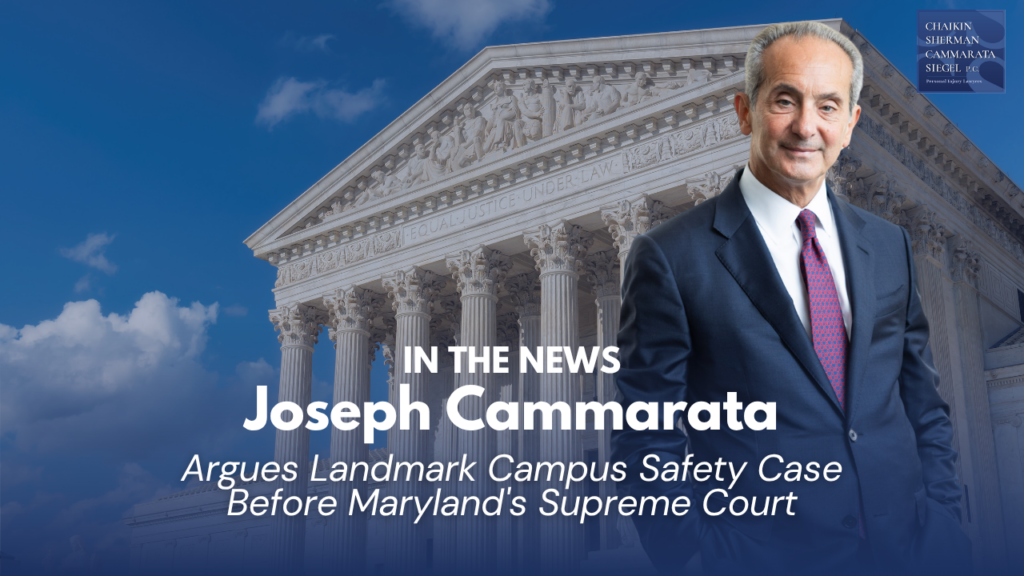
When a university knows danger is unfolding on its campus and does nothing, who bears responsibility for the harm that follows? That question went before Maryland’s highest court on April 10, 2026, as WBAL-TV reported on oral arguments in Torney v. Towson University—a case that could reshape how institutions are held accountable for student safety. CSCS senior partner Joseph Cammarata represented Catherine Torney, a student shot at an unsanctioned party on campus in September 2021. The university knew the party was happening. Campus police were sent. And yet, despite obvious signs of danger—400 intoxicated people, loud music, escalating chaos—they stood by and did nothing.
Towson’s defense hinged on a narrow interpretation of liability: the university couldn’t foresee a gun. Cammarata’s argument reframed the question entirely. Foreseeability isn’t about predicting the specific weapon. It’s about recognizing that a chaotic, unsupervised gathering of intoxicated students creates foreseeable risk of harm—regardless of mechanism. He pointed out that even the DJ recognized the danger and stopped the music. If trained police officers couldn’t see what a DJ could see, why should the university escape liability?
Justice Jonathan Biran’s questions suggested the court understood the stakes. What if people had been trampled? What if injuries came from a bottle instead of a gun? Doesn’t sending campus police to the scene itself acknowledge that the university recognized danger? The Supreme Court’s decision, expected later in 2026, will determine whether universities across Maryland face broader accountability for failing to intervene in escalating dangerous situations on their campuses—and what that obligation means for the students in their care.