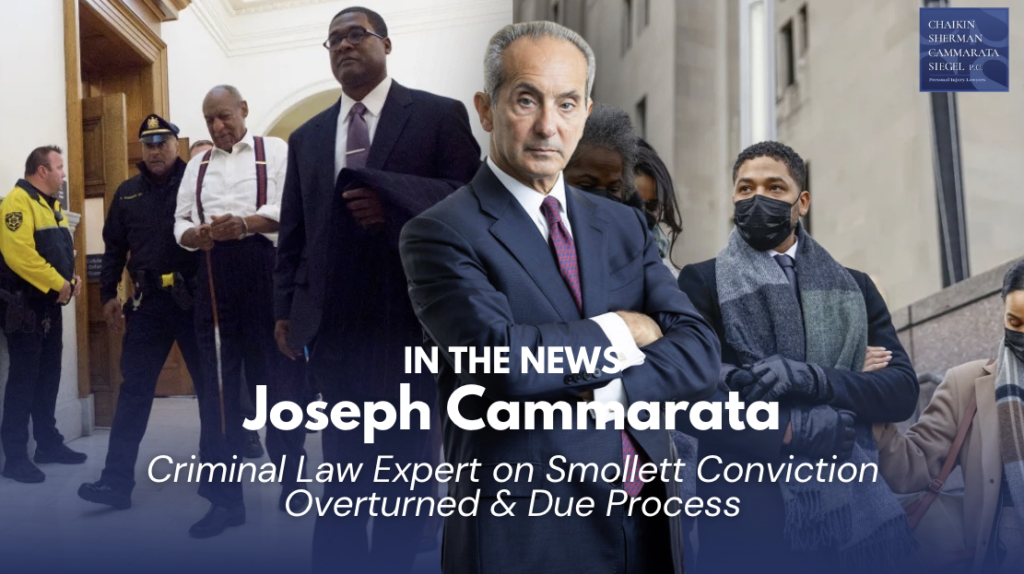
When appellate courts overturn high-profile convictions, they send a powerful message about the rule of law and prosecutorial accountability. The Illinois Supreme Court’s decision to overturn Jussie Smollett’s conviction and Pennsylvania’s reversal of Bill Cosby’s conviction share a striking parallel: both cases involved prosecutors breaking explicit promises to defendants, violating their due process rights. Though the two cases differ dramatically in their details—Smollett’s alleged hate-crime hoax versus Cosby’s sexual assault allegations—the legal principles at stake are identical. Joseph Cammarata, partner at Chaikin, Sherman, Cammarata & Siegel, provided expert analysis to CNN explaining why both courts reached similar conclusions about prosecutorial misconduct.
In Smollett’s case, the original Cook County State’s Attorney’s Office dropped all charges in March 2019 after Smollett performed community service and forfeited his $10,000 bond to the city. Smollett had complied with every term of the agreement. Then, a special prosecutor was appointed in June 2019 who sought to undo what the state had already agreed to, ultimately securing a conviction against Smollett in December 2021. The Illinois Supreme Court rejected this reversal, ruling 5-0 (with two justices abstaining) that the state could not prosecute twice after making and accepting a binding agreement. As Justice Elizabeth M. Rochford wrote: “Because the initial charges were dismissed as part of an agreement with defendant and defendant performed his part of the agreement, the second prosecution was barred.” Cammarata explained the principle to CNN: “A special prosecutor was appointed and sought to undo what the state had agreed to, and the Illinois Supreme Court said, ‘no, we’re not going to allow that because it’s not just, it’s not fair, and the state must be bound by its word.'”
Cosby’s case followed a strikingly similar prosecutorial pattern. Former Montgomery County District Attorney Bruce Castor declined to prosecute Cosby criminally in 2005, instead asking Cosby to testify in a civil lawsuit against him—reasoning that without criminal prosecution threat, Cosby couldn’t invoke Fifth Amendment protection and would have to answer questions under oath. Cosby relied on Castor’s explicit promise not to charge him and testified, waiving his constitutional protections. His testimony was later settled out of court and sealed. But in 2015, when a federal judge unsealed Cosby’s deposition testimony, a new District Attorney took over in Montgomery County. Despite Castor’s predecessor’s decision, she reopened the criminal investigation and prosecuted Cosby using his own sealed testimony against him—testimony he had only given because he was promised immunity. Cosby was convicted in 2018 and sentenced to 3-10 years. Pennsylvania’s Supreme Court vacated the conviction in 2021, ruling that prosecuting Cosby violated his due process rights when he had relied on the original prosecutor’s promise.
These cases aren’t about whether Smollett or Cosby should “get off”—they’re about whether the government itself must follow the law. Entertainment attorney Domenic Romano told CNN the key isn’t celebrity privilege: “The similarity lies in the fact that the state didn’t keep its promise, or the state going back on its word, and I think we would have seen the same result with an ordinary citizen with legal representation.” The courts recognized that when prosecutors make binding commitments to defendants, breaking those commitments—especially under public pressure or political pressure—undermines the entire justice system. Nor do these reversals vindicate the alleged conduct; as Romano emphasized, the overturned convictions do not mean courts are “exonerating or vindicating or endorsing the behavior of either man.” They simply hold the government accountable for honoring its promises.
Prosecutorial integrity matters. The state must be bound by its word. If you’re facing criminal law charges or need defamation representation, contact us to discuss your matter with an experienced trial attorney.